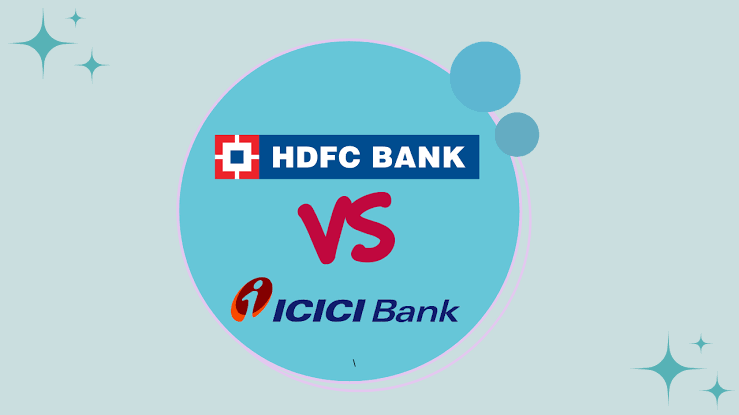
Two of India’s largest private banks sit less than a kilometre apart in Mumbai’s financial district, and millions of Indians choose between them every year based on little more than which branch happened to be closer or which relative recommended it first. HDFC Bank remains India’s largest private lender by market capitalisation, while ICICI Bank has quietly outperformed it on several key financial metrics through 2026. Neither is objectively “better” in every sense — the right choice depends on what you’re actually optimising for. Here’s a genuinely balanced, data-backed comparison.
| Metric (2026 data) | HDFC Bank | ICICI Bank |
| Market capitalisation | ~₹12-14 lakh crore | ~₹9.6-10 lakh crore |
| Net Interest Margin | 3.26-3.43% | 4.30-4.54% |
| Gross NPA | 1.15-1.42% | 1.28-1.53% |
| Net NPA | 0.38-0.42% | 0.33-0.37% |
| Deposits | ~₹31 lakh crore | ~₹18.3 lakh crore |
| Savings account rate | 2.50% p.a. (standard) | 2.50% p.a. (standard) |
Scale: HDFC’s Clear Advantage
If pure size and balance sheet strength matter to you, HDFC Bank remains the undisputed leader in this comparison.
- Holds a meaningfully larger market capitalisation, commonly cited around ₹12-14 lakh crore versus ICICI’s ₹9.6-10 lakh crore
- Deposits stand at roughly ₹31 lakh crore compared to ICICI’s ₹18.3 lakh crore, reflecting HDFC’s larger overall customer base
- Post-merger with HDFC Ltd, the bank now operates the largest private banking balance sheet in India by a considerable margin
- This scale advantage is often described by analysts as a “size premium” the market assigns to HDFC’s shares
Profitability: ICICI’s Growing Edge
Despite trailing on raw size, ICICI Bank has posted stronger profitability metrics through much of 2026, a genuinely significant shift from historical patterns.
- ICICI Bank’s Net Interest Margin has run considerably higher, cited between 4.30-4.54 percent versus HDFC’s 3.26-3.43 percent
- ICICI’s Return on Assets has been reported around 2.25-2.4 percent, compared to HDFC’s 1.8-1.96 percent
- This margin advantage stems partly from ICICI’s large pool of low-cost deposits, letting it maintain superior spreads
- HDFC Bank has faced some post-merger pressure, relying more heavily on comparatively expensive funding sources following its HDFC Ltd integration
Asset Quality: A Genuinely Mixed Picture
Neither bank holds a clean, uncontested lead on asset quality, and the specific metric you examine changes which bank looks stronger.
- HDFC Bank has generally reported a lower Gross NPA ratio, cited around 1.15-1.42 percent versus ICICI’s 1.28-1.53 percent
- ICICI Bank has often reported a lower Net NPA ratio, around 0.33-0.37 percent versus HDFC’s 0.38-0.42 percent
- ICICI’s provisioning coverage ratio on non-performing loans has been reported around 74.7 percent, reflecting conservative risk buffering
- Both banks are widely described as maintaining “pristine” or very strong asset quality relative to the broader Indian banking sector
Loan Growth and Business Momentum
Growth trajectory differs meaningfully between the two, with ICICI generally posting faster expansion in recent reporting periods.
- ICICI Bank’s advances have grown around 16-19 percent year-on-year in recent quarters, outpacing HDFC’s growth rate
- HDFC Bank’s advances grew around 12-15.4 percent in comparable periods, still solid but trailing ICICI’s pace
- ICICI’s deposit growth has also run strong, around 14.7-18 percent, supporting its continued loan book expansion
- This growth differential partly explains why ICICI Bank has drawn increasing analyst attention as the “growth-oriented challenger” to HDFC’s established scale
Everyday Banking: Savings Accounts and Fixed Deposits
For most retail customers, the practical day-to-day banking experience matters more than balance sheet metrics, and here the two banks are genuinely comparable.
- Both banks offer a standardised savings account interest rate of 2.50 percent per annum across regular balance tiers
- HDFC offers 14 distinct savings account variants, including specialised options for women, senior citizens, students, and farmers
- ICICI offers a similarly diverse portfolio including Digital Savings, Silver Savings, and Titanium Privilege accounts targeting different customer segments
- Fixed deposit rates run close between the two, though ICICI has occasionally edged slightly ahead on specific tenures, such as 6-month and 5-year deposits
Valuation: Which Stock Looks Cheaper
For investors specifically, valuation multiples tell a nuanced story that depends on which measure you prioritise.
- HDFC Bank generally trades at a lower Price-to-Book ratio, cited around 1.4-2.1x, partly reflecting its larger post-merger book value
- ICICI Bank trades at a higher Price-to-Book ratio, around 2.4-3.2x, which analysts attribute to its superior Return on Equity
- Price-to-Earnings ratios run fairly close between the two, with ICICI sometimes cited as marginally cheaper on this specific measure
- Neither valuation gap is dramatic enough to make one bank an obvious “better buy” purely on multiples alone, without considering broader growth and risk factors
Frequently Asked Questions
Q1. Which bank is safer for depositing my savings, HDFC or ICICI?
Both are well-capitalised, systemically important private banks with strong asset quality and RBI oversight, so deposit safety is broadly comparable between the two, with DICGC insurance applying equally to both up to the standard limit.
Q2. Does ICICI Bank’s higher NIM mean it’s a better investment than HDFC Bank?
Not necessarily on its own — while ICICI’s margins and growth have been stronger recently, HDFC’s larger scale and lower historical volatility appeal to more conservative, stability-focused investors, so the “better” choice depends on your investment goals.
Q3. Which bank offers better fixed deposit interest rates in 2026?
Rates run very close between the two, with ICICI occasionally offering marginally higher rates on specific tenures like 6-month or 5-year deposits, so it’s worth comparing the exact tenure you’re considering before deciding.
Q4. Should I switch my primary bank account from HDFC to ICICI or vice versa based on these financial metrics?
Probably not purely for that reason — day-to-day banking convenience, branch or ATM proximity, digital app experience, and specific product needs typically matter more for everyday account holders than the underlying bank’s stock performance or balance sheet metrics.